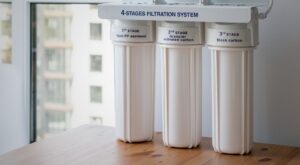
A pitcher filter barely touches the dissolved solids, PFAS and heavy metals that made you worry in the first place. Format decides whether you can install it at all, the pure-to-drain ratio decides what it costs you every month, and remineralization decides whether the water actually tastes like anything. Here are the 10 best reverse osmosis systems of 2026, from tankless under-sink units to countertop machines that need no plumbing.
We do not accept paid sponsorships. If you buy through our links we earn a small commission from Amazon, at no extra cost to you.
Jump to your case
Swipe sideways · tap to open the full review
The full rankingUnder-sink systems and countertop units interleaved by score. Open “Learn more” only if you want the technical detail.
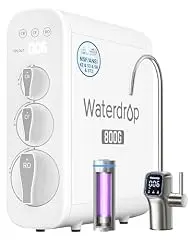
Waterdrop G3P800 Tankless RO System
- 800 GPD fills a glass in seconds
- Tankless, frees up cabinet space
- Smart LED faucet shows filter status
It fixes the two things people actually complain about: slow flow and a bulky tank. The dedicated faucet pours at close to regular tap speed, the body slides into a cabinet without swallowing it, and a UV stage sits on top of the multi-stage filtration.
- Format
- Tankless
- Flow
- 800 GPD
- Extra
- UV stage

Availability changes through the day. Check the listing.
Learn more
The G3P800 tops this list because it removes the two friction points that make people stop using an RO system: waiting for a glass to fill, and losing the entire cabinet under the sink to a pressurized tank. An 800 gallon-per-day rating means the dedicated faucet pours at close to normal tap speed, and the tankless body is compact enough to leave real storage space behind. A UV sterilizer stage joins the standard multi-stage path, and the smart faucet's LED ring changes color to signal water quality and remaining filter life, so cartridge changes stop being guesswork. It is a premium price against tank systems with comparable filtration, but for a household that drinks and cooks with a lot of filtered water, the speed shows up every day.
Pros
- Fastest under-sink flow rate on this list
- Tankless design saves real cabinet space
- LED smart faucet takes the guesswork out of filter changes
Cons
- Premium price compared to tank-based systems with similar filtration
- Needs a power outlet under the sink, unlike tank systems
Best for: busy households that want filtered water at full tap speed.
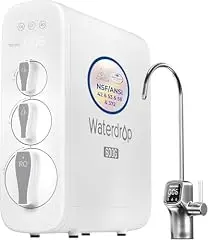
Waterdrop G3 Tankless RO System
- Efficient 2:1 pure-to-drain ratio
- Smart LED faucet with live readout
- Composite filters, fewer cartridges to track
The model that made tankless RO mainstream, and still the sweet spot. Half the flagship's flow but far faster than any tank system, with a 2:1 ratio that wastes a fraction of what older designs send down the drain.
- Format
- Tankless
- Flow
- 400 GPD
- Waste ratio
- 2:1
Learn more
The original G3 is the model that made Waterdrop's name in tankless RO, and it remains one of the most reviewed systems in the category, with a large buyer base vouching for its long-term reliability. Its 400 GPD flow is half the G3P800 above but still far quicker than a tank system, and the 2:1 pure-to-drain ratio wastes considerably less than the older designs that send three or four gallons away per clean gallon, which adds up on a water bill over years. The smart faucet reads water quality in real time, and the composite filter design cuts the number of separate cartridges you have to track. For most households this is where price and capability meet.
Pros
- Large, well-established review base for a tankless system
- 2:1 ratio wastes far less water than older RO designs
- Composite filters simplify replacement tracking
Cons
- Half the flow rate of the flagship pick above
- No UV stage, unlike the G3P800
Best for: buyers who want proven tankless performance without paying flagship prices.
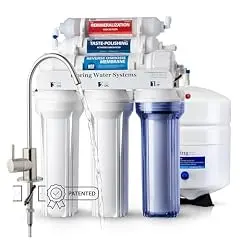
iSpring RCC7AK Alkaline RO System
- Remineralization restores minerals and taste
- NSF-certified filtration
- Six stages at a budget price
The volume leader of the whole category, and the cheapest to run. Six stages including remineralization, NSF certification rather than marketing language, and a transparent first stage so you can see when sediment buildup calls for a change.
- Format
- Tank
- Stages
- 6 + alkaline
- Certified
- NSF
Learn more
The RCC7AK is the volume leader on this entire list by a wide margin, with more verified reviews than any other system here, built over years on the market. It is a traditional tank-based design with six stages, including a remineralization filter that puts calcium, magnesium and other minerals back after the membrane strips everything out, which fixes the flat taste people notice in plain RO water. The filtration carries NSF certification, a genuine third-party check rather than a percentage printed on a box, and the transparent first-stage housing lets you see sediment buildup so a change is never a guess. Installation takes more effort than the tankless picks and the tank eats cabinet space, but the long-term running cost is among the lowest in the category.
Pros
- Largest review base of any system on this list
- Remineralization stage noticeably improves taste
- NSF-certified filtration at a budget-friendly price
Cons
- Storage tank takes up significant under-sink space
- Slower fill than any tankless pick here
Best for: buyers who want the most proven, widely trusted system at the lowest running cost.
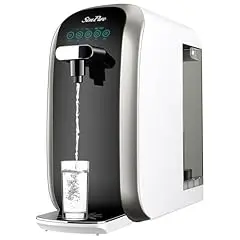
SimPure Y7P-BW UV Countertop RO System
- Zero installation, fill and plug in
- 4:1 ratio with reusable wastewater
- Built-in UV sterilization stage
The best pick for anyone who cannot touch their plumbing. Renters, dorms, offices and RVs: fill the removable tank, and the machine runs RO plus a UV light before dispensing. The concentrate collects separately so you can water plants with it.
- Format
- Countertop
- Waste ratio
- 4:1
- Extra
- UV stage
Learn more
The Y7P-BW is the strongest pick for anyone who cannot or does not want to modify plumbing. It is a self-contained countertop dispenser: you fill the removable tank from the tap, and the machine runs the water through its RO stages plus a UV light before dispensing at the push of a button. The 4:1 pure-to-drain ratio is efficient for a countertop design, and the concentrate collects in a separate compartment you can pour on plants rather than losing it down a drain, which no under-sink system offers. It carries a solid, well-established review base, and buyers frequently mention taking it along when they move. The tradeoff is manual refills instead of an endless supply.
Pros
- No plumbing or installation required at all
- Wastewater collects for reuse instead of going down a drain
- UV stage adds protection beyond standard RO filtration
Cons
- Manual tank refills instead of a continuous water supply
- Occupies permanent counter space
Best for: renters and anyone who wants RO water without touching the plumbing.
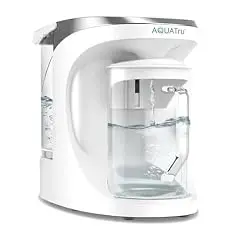
AquaTru Carafe Countertop Purifier
- Four-stage RO, no plumbing
- Dispenses into a removable glass carafe
- BPA-free water-contact parts
The countertop pick that belongs on a dinner table. Filtered water dispenses straight into a removable glass carafe that goes to the fridge or the table, which is genuinely practical if you keep chilled water on hand.
- Format
- Countertop
- Stages
- 4
- Vessel
- Glass carafe
Learn more
AquaTru's Carafe model takes the countertop concept a step further by dispensing into a removable glass carafe that moves straight to the table or the fridge. The four-stage RO process is the same core technology as the under-sink systems higher on this list, packaged into a unit that sets up in minutes with no tools or plumbing. All water-contact parts are BPA-free, and the brand emphasizes independent testing of its contaminant-reduction claims rather than generic percentages. Its review base is smaller than the SimPure above, and the carafe capacity means more frequent refills in a larger household, but for a kitchen where the machine is visible, it is the most presentable option here.
Pros
- Glass carafe moves straight from machine to table or fridge
- Tool-free setup in minutes with no plumbing
- BPA-free water-contact materials
Cons
- Carafe capacity means frequent refills for bigger households
- Smaller review base than the SimPure countertop pick
Best for: design-conscious kitchens that want RO water served from a glass carafe.
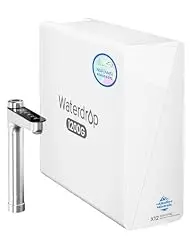
X12 1200 GPD Tankless RO System
- 1200 GPD, the fastest output here
- 11-stage filtration path
- Alkaline stage restores minerals
The most aggressive specification on this list. A flow rating that outpaces even the flagship Waterdrop, pushed through an 11-stage path that ends in alkaline remineralization, attacking both classic RO complaints in one unit.
- Format
- Tankless
- Flow
- 1200 GPD
- Stages
- 11 + alkaline
Learn more
On raw specifications, the X12 is the most aggressive system here: a 1200 gallon-per-day rating that outpaces even the flagship Waterdrop, pushed through an 11-stage filtration path ending in alkaline remineralization. That combination targets slow flow and flat-tasting water in a single tankless under-sink unit. The higher stage count handles sediment, chlorine, dissolved solids and taste-affecting compounds in sequence, and the mineral stage lifts pH slightly for a rounder flavor. Its review base is far smaller than the established names above, which is the main reason it lands mid-list despite the headline numbers. Worth knowing: stage count is a marketing-friendly figure, and the membrane does most of the work regardless of how many housings surround it.
Pros
- Highest flow rating of any system on this list
- 11-stage path plus alkaline remineralization in one unit
- Strong specifications for the price
Cons
- Much smaller review base than the established brands above
- Stage count is a headline figure; the membrane does the real work
Best for: spec-focused buyers who want maximum flow and do not mind a newer brand.
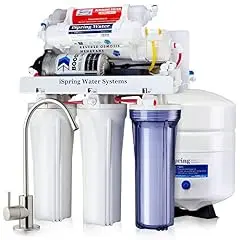
iSpring RCC7P-AK RO System with Pump
- Booster pump for low water pressure
- Alkaline stage restores minerals
- Pump also improves waste efficiency
The answer to a specific problem: weak water pressure. RO performance collapses on low-pressure homes, and this is the RCC7AK with an electric pump that keeps the membrane working at its designed pressure.
- Format
- Tank + pump
- For
- Low pressure
- Alkaline
- Yes
Learn more
This is essentially the RCC7AK from position three with one important addition: an electric booster pump that raises incoming water pressure before it reaches the RO membrane. That matters because reverse osmosis performance drops sharply in homes with weak pressure, typically wells, upper-floor apartments and older plumbing, where a standard system fills slowly and wastes more water in the process. The pump keeps the membrane at its designed pressure, improving both tank fill speed and the pure-to-drain ratio. It shares the alkaline stage and the solid review base of its sibling. The honest advice: the higher price only makes sense if you actually have a pressure problem, which an inexpensive gauge from any hardware store will confirm before you buy.
Pros
- Booster pump solves the low-pressure problem wells and apartments face
- Better water efficiency than non-pumped tank systems
- Same trusted platform as the top-selling iSpring model
Cons
- Pump adds cost that is wasted if your water pressure is already good
- Requires a power outlet, unlike the standard RCC7AK
Best for: homes on well water or with low water pressure.
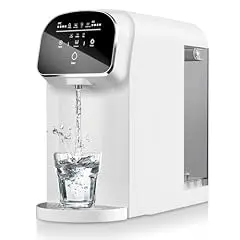
Aigerri Compact 5-Stage Countertop RO
- 5:1 ratio, most water-efficient here
- Compact countertop body
- Five stages, zero plumbing
The least wasteful system on this entire list. A claimed 5:1 pure-to-drain ratio beats every other pick here, in a footprint smaller than most coffee machines and a setup that is just unbox, rinse and plug in.
- Format
- Countertop
- Waste ratio
- 5:1
- Stages
- 5
Learn more
Aigerri's countertop unit competes directly with the SimPure above but pushes efficiency harder, with a claimed 5:1 pure-to-drain ratio that makes it the least wasteful design on this list. The five-stage path runs from a manually filled tank, so setup is nothing more than unboxing, rinsing the filters and plugging it in, and the compact footprint takes less counter space than most coffee machines. It is a newer listing with a small review base so far, which is why it sits below the established countertop picks despite the strong efficiency numbers. For a second unit in an office or a guest suite, the size and price make it a low-risk experiment.
Pros
- Most water-efficient ratio of any pick on this list
- Smaller footprint than most countertop competitors
- Simple setup with no tools or plumbing
Cons
- Small review base so far compared to the established countertop picks
- No UV stage, unlike the SimPure countertop pick
Best for: tight counters and buyers who prioritize water efficiency.
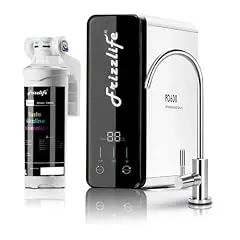
Frizzlife PD600-TAM3 RO System
- 600 GPD tankless flow
- Compact body preserves cabinet space
- Alkaline stage included, not extra
Tankless speed and alkaline taste at a value price. 600 GPD in a compact under-sink body, with quick-connect fittings most people manage without calling a plumber, and the mineral stage built in rather than sold separately.
- Format
- Tankless
- Flow
- 600 GPD
- Alkaline
- Included
Learn more
The PD600-TAM3 is the value alternative to the Waterdrop tankless systems at the top of this list, delivering 600 GPD with an alkaline remineralization stage in a compact under-sink body. It carries a solid, well-established review base, and buyers frequently mention how straightforward the installation is thanks to quick-connect fittings that most people manage in an afternoon. The alkaline stage adds trace minerals back after the membrane, addressing the flat-taste complaint without a separate add-on filter. Its faucet and monitoring are simpler than the smart LED setups on the Waterdrop systems, which is the main trade for the lower price, but the core filtration and flow land closer to the premium picks than the price gap suggests.
Pros
- Tankless 600 GPD flow at a value-oriented price
- Alkaline stage included rather than sold separately
- Quick-connect fittings simplify self-installation
Cons
- Simpler faucet and monitoring than the smart systems above
Best for: buyers who want tankless speed and alkaline taste at a lower price.
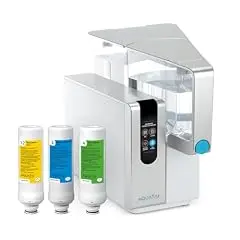
AquaTru Classic Countertop RO System
- PFAS reduction, independently tested
- Tool-free setup in minutes
- Twin-tank design shows water level
The PFAS-focused pick, with test data behind the claim. The same four-stage process as the Carafe in a larger twin-tank body, and the brand leans on independent testing rather than percentages printed on a box.
- Format
- Countertop
- Stages
- 4
- Focus
- PFAS
Learn more
Rounding out the list, the AquaTru Classic is the brand's original countertop design, built on the same four-stage RO process as the Carafe above but with a larger plastic dispensing tank instead of the glass carafe. AquaTru leans heavily on independent testing of its contaminant-reduction claims, with PFAS reduction featured prominently, which matters in areas with documented forever-chemical contamination. Setup is genuinely tool-free, and the twin-tank design shows at a glance how much filtered water is ready. This particular listing carries a small review base so far, which combined with the dated look of the original design places it at the bottom of an otherwise strong field. The filtration underneath remains very capable.
Pros
- PFAS reduction claims backed by independent testing
- Genuinely tool-free setup out of the box
- Twin-tank design shows filtered water level at a glance
Cons
- Small review base on this listing and a dated design
- Larger counter footprint than the Carafe sibling
Best for: buyers focused on PFAS reduction without any plumbing work.
Side-by-side comparisonFilter by format and feature, then compare on one screen.
| Model | Format | Flow / supply | Standout feature | Score | Review |
|---|---|---|---|---|---|
| 1. Waterdrop G3P800Best overall | Under-sink, tankless | 800 GPD | Smart LED faucet and UV stage | 9.8 | Open |
| 2. Waterdrop G3Best value | Under-sink, tankless | 400 GPD | 2:1 ratio, proven track record | 9.5 | Open |
| 3. iSpring RCC7AKMost proven | Under-sink, tank | 75 GPD | Most reviewed, NSF certified | 9.2 | Open |
| 4. SimPure Y7P-BW | Countertop | Fill-tank dispenser | UV stage, reusable wastewater | 8.9 | Open |
| 5. AquaTru Carafe | Countertop | Fill-tank dispenser | Removable glass carafe | 8.6 | Open |
| 6. X12 Tankless ROFastest | Under-sink, tankless | 1200 GPD | 11 stages plus alkaline | 8.3 | Open |
| 7. iSpring RCC7P-AK | Under-sink, tank | 75 GPD + pump | Booster pump for low pressure | 8.0 | Open |
| 8. Aigerri 5-Stage | Countertop | Fill-tank dispenser | 5:1 ratio, most water-efficient | 7.7 | Open |
| 9. Frizzlife PD600-TAM3 | Under-sink, tankless | 600 GPD | Tankless value with alkaline stage | 7.4 | Open |
| 10. AquaTru Classic | Countertop | Fill-tank dispenser | Independently tested PFAS claims | 7.1 | Open |
Swipe the table sideways →
Which system actually fits youThe first question is not which brand. It is whether you are allowed to touch the plumbing.
Find your RO system
No sign-up. The recommendation updates instantly.
Speed above all, with plumbing access: 800 GPD pours at close to tap speed, the tankless body keeps your cabinet, and a UV stage plus LED faucet handle the rest.
Open the Waterdrop G3P800Guidance based on the 10 systems in this ranking. Test your water with a TDS meter or your municipal report before deciding what you actually need to filter.
Waste, minerals and running costThe pure-to-drain ratio and remineralization stage per system, the two specs that shape your bill and your taste.
| Model | Format | Waste ratio | Remineralized | Install effort |
|---|---|---|---|---|
| Aigerri Compact 5-Stage | Countertop | 5:1 | No | Unbox and plug in |
| SimPure Y7P-BW | Countertop | 4:1, reusable | No, has UV | Unbox and plug in |
| Waterdrop G3 | Tankless | 2:1 | No | Under-sink, quick-connect |
| Waterdrop G3P800 | Tankless | Manufacturer rated | No, has UV | Under-sink, quick-connect |
| X12 1200 GPD Tankless | Tankless | Manufacturer rated | Yes, alkaline | Under-sink, quick-connect |
| Frizzlife PD600-TAM3 | Tankless | Manufacturer rated | Yes, alkaline | Under-sink, quick-connect |
| iSpring RCC7AK | Tank | Traditional design | Yes, NSF certified | Full under-sink install |
| iSpring RCC7P-AK | Tank + pump | Improved by pump | Yes, alkaline | Full install plus outlet |
| AquaTru Carafe | Countertop | Manufacturer rated | No | Tool-free, minutes |
| AquaTru Classic | Countertop | Manufacturer rated | No | Tool-free, minutes |
Swipe the table sideways →
Before you check out
The system is a one-time cost; cartridges are forever. Price out a full set of replacement filters before you buy, because a cheap system with expensive proprietary cartridges costs more within two or three years than a pricier one with affordable filters. And test your water first: a TDS meter costs very little, and your municipality publishes an annual water quality report. Knowing what is actually in your water tells you whether you need a UV stage, a PFAS-focused unit, or simply good general filtration.
Get it right from the first glassFour steps that prevent the problems people post about three months in.
- Flush the system before you drink anythingNew membranes and carbon filters ship with preservative residue and carbon fines. Run and discard the first several tanks or the volume your manual specifies; water that tastes odd on day one is almost always a system that was not flushed.
- Measure your water pressure before installingAn inexpensive gauge on any faucet tells you whether your home is in the range RO membranes need. Low pressure means slow fills, more waste and shorter membrane life, and it is the single reason the booster-pump model exists.
- Test with a TDS meter, before and afterTake a reading of your tap water, then of the filtered output once the system settles. That first pair of numbers is your baseline, and a rising filtered reading later is the clearest signal that the membrane is nearing the end of its life.
- Log the install date and set filter remindersPre-filters and carbon stages typically run 6 to 12 months, membranes 2 to 3 years. Write the date on each housing with a marker and put the next change in your calendar, because an overdue pre-filter is what kills an expensive membrane early.
Signs something is off
A slow trickle from a tank system usually means the tank has lost its air charge, not that the membrane failed; the tank pressure is adjustable with a bicycle pump. A rising TDS reading in filtered water means the membrane is failing or a pre-filter is overdue. Water that tastes flat is normal for RO without a mineral stage, and an inline remineralization filter fixes it cheaply. Constant draining that never stops points to a stuck flow restrictor or check valve.
Which one to choose for each situation
- Filtered water at full tap speedWaterdrop G3P800, with 800 GPD flow and a smart LED faucet. Open the review
- Proven tankless performance for lessWaterdrop G3, with a 2:1 ratio and a large review base. Open the review
- The most trusted system at the lowest running costiSpring RCC7AK, the most reviewed pick here. Open the review
- Renting, or unable to touch the plumbingSimPure Y7P-BW, a plug-in countertop unit with a UV stage. Open the review
- RO water served from a glass carafeAquaTru Carafe, the most presentable countertop option. Open the review
- Maximum flow and stage countX12 1200 GPD Tankless RO System, the fastest specification here. Open the review
- Well water or weak pressureiSpring RCC7P-AK, built around a booster pump. Open the review
- Wasting the least water possibleAigerri Compact 5-Stage, with a 5:1 pure-to-drain ratio. Open the review
- Tankless speed on a tighter budgetFrizzlife PD600-TAM3, 600 GPD with an alkaline stage. Open the review
- Worrying specifically about PFASAquaTru Classic, with independently tested reduction claims. Open the review
Tankless, tank or countertop: which format is yours
Every system here works the same way underneath: household pressure pushes water through a semi-permeable membrane whose pores block dissolved solids, heavy metals and most chemical contaminants, sending the concentrate away as wastewater. The membrane technology is the same across all three formats, so none of them filters "better" by nature. What differs is how it connects to your home.
- Tankless under-sink (ranks 1, 2, 6 and 9). Filters on demand at high flow rates, no storage tank, compact body, and typically a smart faucet. Costs more upfront and needs a power outlet, but pours at close to tap speed and leaves your cabinet usable.
- Tank under-sink (ranks 3 and 7). Slowly fills a pressurized storage tank, which is why the GPD figure looks low. Cheapest to buy and to run, with the longest track records in the category, at the cost of cabinet space and a slower refill after heavy use.
- Countertop (ranks 4, 5, 8 and 10). No plumbing at all: fill a tank by hand, dispense at a button. The only realistic option for renters, dorms, offices and RVs, and the only format you can take with you when you move. The trade is manual refills and permanent counter space.
Waste ratio and filter cost: the two numbers that decide everything
Two figures determine what an RO system really costs you, and neither is the price on the listing. The pure-to-drain ratio is how many gallons go down the drain per clean gallon produced. Older designs run 3:1 or 4:1, modern ones 2:1 or better, and countertop units here reach 4:1 and 5:1 with the concentrate collected for reuse. Over years of daily drinking and cooking, that difference lands on your water bill. Filter replacement cost is the other half: pre-filters and carbon stages run 6 to 12 months, the membrane 2 to 3 years, and proprietary cartridges from a small brand can cost more annually than a cheaper system saved you upfront.
The honest rule of thumb: decide the format first, because that is the only decision your home actually forces on you. Then compare waste ratio and a full set of replacement filters across the shortlist, not headline specifications. Stage count in particular is marketing-friendly and nearly meaningless on its own, since the membrane does the real work and the extra housings are mostly sediment and carbon. A certified six-stage system beats an uncertified eleven-stage one every time.
- 3:1 or 4:1. Older tank designs. Still perfectly effective at filtering, but they send three or four gallons away per clean gallon.
- 2:1. The modern tankless standard. Roughly half the waste of the older designs, and the range most current under-sink systems target.
- 4:1 to 5:1 with reuse. The countertop picks here, where the concentrate collects in a compartment you can pour on plants rather than losing it entirely.
Frequently asked questions
What does a reverse osmosis system actually remove?
Reverse osmosis membranes block the vast majority of dissolved solids, including lead, arsenic, fluoride, nitrates and most salts, along with many chemical contaminants such as PFAS when paired with carbon pre-filters. Exact reduction rates vary by system, which is why certified or independently tested claims matter more than generic percentages.
Why do RO systems waste water, and how much?
The membrane needs a stream of water to carry away the concentrated contaminants it rejects, so some water always goes to the drain. Older systems wasted three to four gallons per purified gallon, while modern designs run at 2:1 or better, and some countertop units collect the concentrate for reuse on plants.
Does reverse osmosis remove healthy minerals too?
Yes, the membrane cannot distinguish helpful calcium and magnesium from harmful contaminants, so it removes both. That is why many systems now include a remineralization or alkaline stage that adds minerals back after filtration, which also improves the taste most people describe as flat in plain RO water.
What is the difference between tankless and tank-based systems?
Tank systems filter water slowly into a pressurized storage tank, which takes up cabinet space and can affect taste if water sits for long periods. Tankless systems filter on demand at much higher flow rates and save space, but typically cost more upfront and need electricity.
How often do the filters need replacing?
Pre-filters and carbon stages typically need replacement every 6 to 12 months, while the RO membrane itself usually lasts 2 to 3 years depending on water quality and usage. Many modern systems track filter life electronically and signal when a change is due.
Can I install an under-sink RO system myself?
Most current systems use quick-connect fittings and include hardware for drilling the faucet hole and tapping the drain line, and many buyers complete the installation in one to two hours with basic tools. If your countertop is stone or you are uncomfortable drilling, a plumber visit or a countertop system avoids the issue entirely.
Is reverse osmosis water safe to drink every day?
Yes, RO water is safe for daily drinking, and it is one of the most thorough home filtration methods available. People who want the mineral content of regular tap water can choose a system with a remineralization stage, which restores calcium and magnesium after filtration.
How we evaluated these reverse osmosis systems
Our evaluation is editorial. We compare the most searched models on Amazon by cross-referencing manufacturer specifications with the reviews of people who already bought them.
- Filtration performance, how many stages the system uses and which contaminants, from dissolved solids to PFAS, it is designed to reduce.
- Water flow and daily output, the rated gallons-per-day figure and how quickly the system actually fills a glass or a pot.
- Pure-to-drain ratio, how much water goes down the drain for every gallon of purified water, which affects both your water bill and the environment.
- Installation and format, whether the unit requires under-sink plumbing work or sits on the counter ready to use out of the box.
- Remineralization, whether the system adds healthy minerals back after filtration, which affects taste and pH.
- Filter life and replacement cost, how often cartridges need changing and how easy the swap actually is.
- Cost-to-value ratio, whether the asking price lines up with the filtration performance, capacity and build quality delivered.
No brand pays for placement. Our links are affiliate links: if you buy through them we earn a small commission at no extra cost to you. Learn how we select products.
Conclusion
The right reverse osmosis system in 2026 comes down to one question first: can you modify your plumbing? If yes, the Waterdrop G3P800 and Waterdrop G3 lead the tankless field with fast flow and smart monitoring, while the iSpring RCC7AK remains the most proven, most reviewed choice with the lowest running costs, and its sibling iSpring RCC7P-AK adds a booster pump for homes with weak pressure. The X12 1200 GPD and Frizzlife PD600-TAM3 both undercut the premium picks while keeping tankless speed and alkaline remineralization.
If plumbing is off the table, the countertop field is stronger than ever: the SimPure Y7P-BW pairs RO with a UV stage and reusable wastewater, the AquaTru Carafe serves filtered water from an elegant glass carafe, the Aigerri Compact 5-Stage leads the list on water efficiency, and the AquaTru Classic puts independently tested PFAS reduction on any counter without tools.
Test your water before you shop, price out a full set of replacement filters, and be honest about whether you rent or own. Then pick the system on this list that matches your kitchen and your water, not the one with the biggest number on the box.