Have you ever bought an electric skateboard based on the top speed number alone, only to find the real-world range barely covers half your commute? Marketing tends to gloss over the details that matter most: advertised top speeds are usually best-case with a lighter rider, belt-drive motors climb hills better than hub motors but need more maintenance, and battery range drops noticeably in cold weather or on hilly routes. So we will cut to the chase: here are the ten best electric skateboards on Amazon right now, from budget commuter boards to off-road machines, what each does well, who it fits, and where it falls short.
↓ Jump straight to the rankingHow we evaluated these electric skateboards
Our evaluation is editorial and weighs objective technical criteria, based on the study of manufacturer specifications and real buyer reviews.
- Top speed and motor power: how the stated top speed and motor wattage translate to real acceleration and hill-climbing ability.
- Range per charge: how far the board realistically travels on a full charge, accounting for rider weight and terrain.
- Deck construction and durability: the materials used, from bamboo and maple to carbon fiber, and how well the deck holds up to daily use.
- Terrain capability: whether the board is built for smooth streets, rougher pavement, or genuine off-road riding.
- Braking and safety features: the responsiveness of regenerative braking and the quality of the included remote control.
- Portability and weight: how easy the board is to carry, store, or bring along on a commute.
- Cost-to-value ratio: whether the asking price lines up with the power, range, and build quality delivered.
No brand pays for placement on this list. The links below are affiliate links, and if you buy through them we may earn a small commission at no extra cost to you.
Ranking: the 10 best electric skateboards
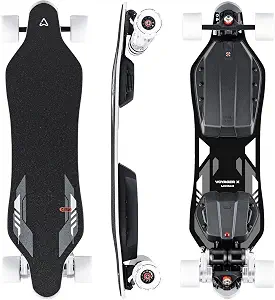
MEEPO Voyager X Electric Skateboard
- Dual 2800-watt motors reach a 34 mph top speed.
- 648Wh battery delivers up to 30 miles of range.
- Bamboo and fiberglass deck built for stability at speed.

Learn more
MEEPO's Voyager X sits at the top of this list on raw capability, pairing dual 2800-watt high-torque motors with a 648Wh Samsung battery pack rated for up to 30 miles per charge. That combination is enough to climb inclines of up to 46 percent, a genuinely steep grade most commuter boards cannot handle. The deck combines a layer of fiberglass with bamboo construction, aiming for a strong rebound feel for riders who want a lively ride rather than a stiff plank. It is also the most expensive board on this list, and its review count is still relatively small for a flagship model, so it is worth reading recent feedback before committing to this price point.
Pros
- Dual 2800-watt motors deliver serious power and hill-climbing ability
- 30-mile range covers long commutes on a single charge
- Bamboo and fiberglass deck offers a lively, responsive ride feel
Cons
- Highest price on this list, with a comparatively modest review count
Best for: experienced riders who want maximum power and range for long commutes.
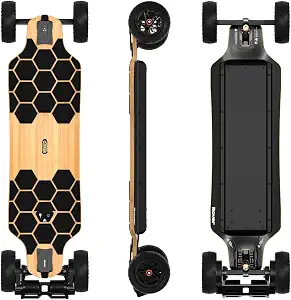
MEEPO Bamboo Rover Electric Skateboard
- Dual 1800-watt motors climb 30-degree slopes with ease.
- 8-inch pneumatic tires absorb bumps on rough terrain.
- 42-inch maple and carbon fiber deck built for off-road rides.
Learn more
This Rover-style board from MEEPO's Bamboo Series is built specifically for off-road terrain, pairing dual 1800-watt motors with 8-inch pneumatic tires that soak up bumps a standard street board would struggle with. The 42-inch deck combines Canadian maple with carbon fiber, and a 10Ah removable battery is rated for a real-world range of roughly 20 miles even under off-road conditions. It is priced well below the flagship pick above while still offering genuine mountain-board capability, though its review count remains on the smaller side for now as a newer listing in this specific configuration.
Pros
- Pneumatic off-road tires handle rough terrain that street boards cannot
- Dual 1800-watt motors climb steep 30-degree slopes
- Removable battery simplifies charging and swaps
Cons
- Smaller review count than the more established picks below
Best for: riders who want genuine off-road and mountain-terrain capability.
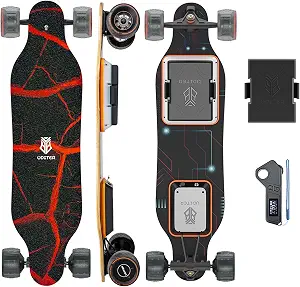
UDITER Electric Skateboard
- Swap-and-go battery system removes charging downtime.
- Dual 600-watt motors reach up to 28 mph.
- Four speed modes suit both beginners and experienced riders.
Learn more
UDITER's standout feature is a swappable battery system, letting riders carry a spare and change it in seconds instead of waiting hours to recharge mid-trip. This particular configuration pairs dual 600-watt motors with a single battery for a 12 to 25 mile range depending on riding style, and the board supports four distinct speed modes so new riders can start slow before working up to the full 28 mph top speed. It carries a solid, well-established review base for a mid-priced board, and the modular battery approach is genuinely useful for anyone commuting longer distances than a single charge comfortably covers.
Pros
- Swappable battery system eliminates mid-trip charging waits
- Four speed modes ease new riders into higher speeds
- Solid review base for a mid-priced board
Cons
- Extra batteries and higher-capacity configurations add significantly to the price
Best for: commuters who want the option to swap batteries instead of waiting to recharge.
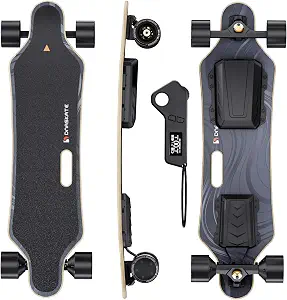
DNASKATE V4 Electric Skateboard
- Dual 500-watt hub motors climb 30 percent grade hills.
- Hub-motor design needs no belt maintenance.
- Quiet operation keeps rides low-key around the neighborhood.
Learn more
DNASKATE takes a hub-motor approach with this model rather than the belt-drive systems used by most boards on this list, and the tradeoff pays off in noise and maintenance. Dual 500-watt hub motors reach a 28 mph top speed and handle 30 percent grade hills without the belt tension checks belt-drive boards eventually need. It carries the highest average rating of any board on this list, backed by a healthy number of reviews, and the 40-inch deck with 11-inch width gives riders a stable, plantable stance. Buyers consistently mention how quiet it runs compared to belt-driven alternatives they have owned previously.
Pros
- Highest average rating of any board on this list
- Hub motors run quieter and need less maintenance than belt drives
- Wide, stable deck suits riders who like a plantable stance
Cons
- Hub motors generally offer less raw torque than belt-drive systems
Best for: riders who want a quiet, low-maintenance board for daily street riding.
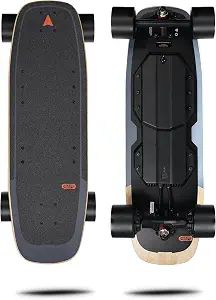
MEEPO Mini5 Electric Skateboard
- Compact maple cruiser deck fits in a backpack.
- Rated for riders up to 330 pounds.
- Reaches up to 32 mph depending on riding mode.
Learn more
MEEPO's Mini5 shrinks the brand's usual longboard format down to a 30 to 34 inch maple cruiser deck with a practical kick-tail, making it noticeably easier to carry and store than the full-size boards higher on this list. It still delivers a genuinely wide 11 to 24 mile range and a top speed that climbs as high as 32 mph on the fastest belt-driven configuration, and its 330-pound max load rating is generous for a board this compact. The tradeoff for the smaller deck is a slightly less stable ride at top speed compared to longer boards, something worth keeping in mind if you are a taller or heavier rider.
Pros
- Compact deck is genuinely easier to carry and store
- 330-pound max load is generous for a board this size
- Multiple drive configurations let buyers choose speed versus price
Cons
- Shorter deck feels less stable at top speed than longer boards
Best for: riders who want an easy-to-carry board without giving up real speed and range.
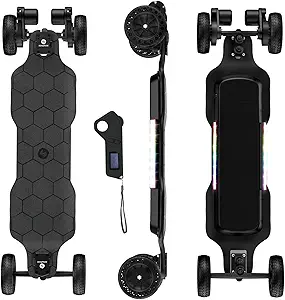
isinwheel Off-Road Electric Skateboard
- Dual 1500-watt belt-drive motors hit a 32 mph top speed.
- LCD remote adjusts acceleration, braking, and lighting.
- IP54 rating handles light rain and dust.
Learn more
isinwheel brings dual 1500-watt belt-drive motors and a 28-mile range to this off-road-capable board, with an added touch of ambient LED lighting along the deck edges for visibility during evening rides. The smart LCD remote gives precise control over acceleration, braking, and lighting settings, and an IP54 rating means light rain or dusty trails will not immediately cause problems. It is currently a newer listing with a very small number of reviews so far, which makes it harder to fully verify long-term reliability compared to the more established boards on this list, even though early feedback and the specification sheet are both promising.
Pros
- Dual 1500-watt motors deliver strong power for the price
- Ambient lighting adds visibility for evening rides
- IP54 rating adds real protection against rain and dust
Cons
- Very small number of reviews so far compared to other picks on this list
Best for: early adopters who want strong specs and do not mind a thin review history.
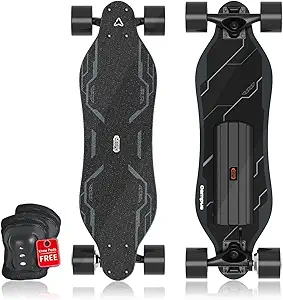
MEEPO Campus Electric Skateboard
- Compact 26.7-inch deck is easy to carry and store.
- Four speed modes let new riders ease into faster settings.
- Built-in handle makes it simple to carry between rides.
Learn more
MEEPO positions Campus as an entry-level board built specifically for students and beginners, and the compact 26.7-inch deck reflects that goal, fitting easily into a dorm room or a car trunk. A four-speed remote lets first-time riders start at a gentle pace before working up to the board's 29 mph top speed once they feel comfortable, and a carry handle molded into the deck makes it simple to bring along rather than skate the whole way. Its average rating trails some other picks here, with a handful of buyers noting the learning curve takes longer than expected for total beginners.
Pros
- Compact deck is genuinely easy to carry and store
- Four speed modes are well suited to first-time riders
- Molded carry handle makes it easy to bring along
Cons
- Average rating trails several other picks on this list
Best for: students and total beginners who want a compact, easy-to-carry board.
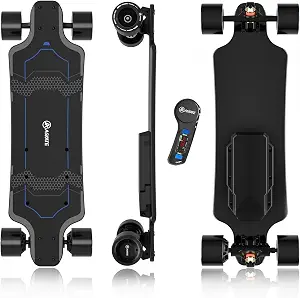
ASKATE A1 Electric Skateboard
- LED remote screen shows battery level and live speed.
- UL2272-certified battery adds a real safety certification.
- 8-ply Canadian maple deck absorbs shock on rough pavement.
Learn more
ASKATE targets younger and less experienced riders with the A1, backed by a battery that carries UL2272 certification, a real third-party safety standard rather than just marketing language. The LED remote screen displays battery level, live speed, and logged mileage, which gives new riders and their parents an easy way to monitor a ride in progress. It is rated for up to 17 miles per charge, and the 8-ply Canadian maple deck adds a reasonable amount of flex and shock absorption over rough pavement. It carries a solid, well-established review base for a board at this price point.
Pros
- UL2272-certified battery adds genuine third-party safety verification
- LED remote display helps monitor speed and battery in real time
- Solid review base for a board at this price
Cons
- Lower average rating than several pricier picks on this list
Best for: younger or newer riders whose parents want a certified battery and live monitoring.
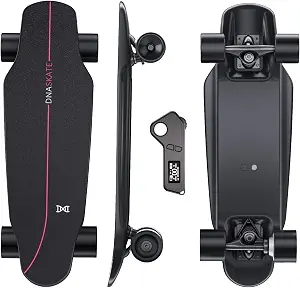
DNASKATE M8 Electric Skateboard
- 400-watt brushless hub motor needs less upkeep than belt drives.
- Integrated battery design adds ground clearance for rough terrain.
- Works as a regular skateboard too if the motor is off.
Learn more
DNASKATE's M8 is a newer model built around an integrated body design, with the battery housed inside the deck itself rather than bolted underneath, which gives it more ground clearance for rougher terrain. The 400-watt brushless hub motor is described by the brand as more reliable and lower-maintenance than the belt-drive systems used on most other boards here, and it doubles as a normal push skateboard if you ever want to ride it with the motor off. At 11.5 pounds and 28 inches long, it is one of the lighter, more compact boards on this list, though its 15 mph top speed and 9 mile range are noticeably more modest than the longboard-style picks higher up.
Pros
- Integrated body design adds ground clearance without extra bulk
- Doubles as a regular push skateboard with the motor off
- Lightweight at just 11.5 pounds for easy carrying
Cons
- Top speed and range are modest compared to the longboard-style picks above
Best for: short local trips where portability matters more than top speed.
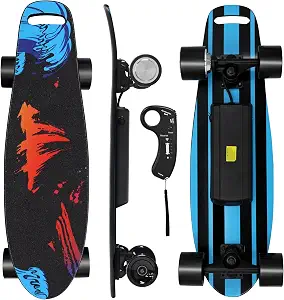
EBOSSOM Electric Skateboard
- 350-watt brushless motor is sized for young, beginner riders.
- Four speed modes cap out at a gentle 10 mph.
- Wireless remote lets parents monitor speed and braking.
Learn more
Rounding out the list, EBOSSOM's ES6 SE is purpose-built for the youngest and least experienced riders on this list, capping its top speed at a deliberately gentle 10 mph across four selectable speed modes. The 350-watt brushless motor and 27-inch, 8-layer deck are sized for lighter riders rather than adults, and a 6 to 8 mile range is more than enough for the shorter rides this board is designed around. The wireless remote is intuitive enough for a parent to hand to a first-time rider with minimal instruction, and the low top speed acts as a built-in safety limit while a young rider builds confidence.
Pros
- Deliberately capped 10 mph top speed suits young, first-time riders
- Lightweight deck sized appropriately for younger riders
- Simple wireless remote is easy for beginners to learn
Cons
- Top speed and range are too limited for teens or adults wanting a faster ride
Best for: younger riders ages 12 and up who are just starting out.
Quick comparison table
| # | Model | Top Speed | Range | Standout Feature | Score |
|---|---|---|---|---|---|
| 1 | MEEPO Voyager X | 34 mph | 30 mi | Climbs up to 46% grades | 9.8 |
| 2 | MEEPO Bamboo Rover | 28 mph | 20 mi | 8-inch pneumatic off-road tires | 9.5 |
| 3 | UDITER Electric Skateboard | 28 mph | 12 to 25 mi | Swap-and-go battery system | 9.2 |
| 4 | DNASKATE V4 | 28 mph | 22 mi | Quiet hub motors, best rated | 8.9 |
| 5 | MEEPO Mini5 | 32 mph | 11 to 24 mi | Backpack-size, 330 lb load | 8.6 |
| 6 | isinwheel Off-Road | 32 mph | 28 mi | Deck lighting + IP54 rating | 8.3 |
| 7 | MEEPO Campus | 29 mph | Short commute | Molded carry handle | 8.0 |
| 8 | ASKATE A1 | Beginner-focused | 17 mi | UL2272-certified battery | 7.7 |
| 9 | DNASKATE M8 | 15 mph | 9 mi | Doubles as a push skateboard | 7.4 |
| 10 | EBOSSOM Electric Skateboard | 10 mph | 6 to 8 mi | Speed capped for young riders | 7.1 |
Which one should you choose
If you are still torn between two or three options, this shortcut matches common needs to the right pick from the list above:
- Want maximum power and range for long commutes The MEEPO Voyager X, with dual 2800-watt motors and 30 miles of range.
- Need genuine off-road and mountain capability The MEEPO Bamboo Rover, built around pneumatic off-road tires.
- Commute farther than one charge covers The UDITER Electric Skateboard, with a swap-and-go battery system.
- Want the quietest, lowest-maintenance ride The DNASKATE V4, built around hub motors instead of belts.
- Want real speed in an easy-to-carry board The MEEPO Mini5, with a compact cruiser deck.
- Want strong specs and do not mind a newer brand The isinwheel Off-Road Electric Skateboard, with dual 1500-watt motors.
- Are a student or total beginner The MEEPO Campus, with a compact deck and four speed modes.
- Want a certified battery with live monitoring The ASKATE A1, backed by a UL2272-certified battery.
- Mainly want short, portable local rides The DNASKATE M8, with an integrated, lightweight design.
- Are buying for a young, first-time rider The EBOSSOM Electric Skateboard, capped at a gentle 10 mph.
Belt-drive vs. hub motors: how they differ
Every electric skateboard on this list uses one of two motor designs, and the choice affects power, noise, and how much maintenance the board eventually needs. Belt-drive motors sit alongside the wheels and turn them through a rubber belt, similar to a bicycle chain, which generally delivers more torque and better hill-climbing power. That extra power comes with tradeoffs, belts stretch over time and need occasional tightening, and the exposed motors and pulleys tend to be louder and pick up more dirt and debris than an enclosed design.
Hub motors are built directly into the wheel itself, with no belt or exposed pulley system at all. This makes them quieter, lower-maintenance, and generally sleeker looking, since there are fewer moving parts to wear out or catch debris. The tradeoff is torque, hub motors typically cannot match a comparable belt-drive setup on steep hills or with heavier riders. For flat, everyday commuting, hub motors are often the more practical choice, while belt-drive boards still lead for hill-climbing and off-road performance.
How to choose: what to check before buying
Before you commit to a purchase, run through this checklist. It covers the details that matter most once you are actually riding the board day to day:
- Match top speed and power to your skill level. A 30-plus mph board is genuinely dangerous for a first-time rider, while a capped-speed board will frustrate an experienced one.
- Check real-world range, not just the marketed number. Rider weight, hills, and cold weather all reduce range below the advertised best case.
- Decide between belt-drive and hub motors. Belt drives climb hills better; hub motors run quieter and need less upkeep.
- Consider deck size against portability needs. A longer deck rides more stably at speed, while a compact deck is easier to carry and store.
- Look at terrain capability if you ride off pavement. Pneumatic off-road tires handle bumps and gravel that standard wheels cannot.
- Weigh price against genuine safety certifications. A certified battery, like UL2272, is worth more than an impressive-sounding spec sheet alone.
Frequently asked questions
How fast can an electric skateboard safely go for a beginner?
Most safety-focused guidance suggests beginners stay under 15 mph while learning balance and braking, even if the board is capable of much higher speeds. Many boards include multiple speed modes specifically so new riders can start slow and work up gradually.
Do I need a special license to ride an electric skateboard?
Rules vary significantly by state and city, with some areas treating electric skateboards like bicycles and others restricting or banning them from certain roads and sidewalks. It is worth checking local regulations before riding on public streets.
How long does the battery actually last before needing a charge?
Advertised range figures are usually measured under ideal conditions with a lighter rider on flat ground, so real-world range is often 10 to 20 percent lower depending on rider weight, hills, and temperature. Battery capacity also gradually declines over hundreds of charge cycles.
What is the difference between belt-drive and hub motors?
Belt-drive motors sit beside the wheels and turn them through a rubber belt, generally offering more torque for hills at the cost of more noise and occasional maintenance. Hub motors are built into the wheel itself, running quieter with less upkeep but typically less raw climbing power.
Can an electric skateboard handle hills and rough terrain?
This depends heavily on the specific board, motor power, and tire type. Boards with pneumatic off-road tires and higher-wattage motors handle hills and rough surfaces far better than street-focused boards with smaller polyurethane wheels.
How do I maintain an electric skateboard's battery long-term?
Avoiding letting the battery sit fully drained for long periods, and not leaving it on a charger indefinitely once full, both help preserve capacity over time. Storing the board in moderate temperatures rather than extreme heat or cold also extends battery life.
What safety gear should I wear when riding?
A helmet is the most important piece of safety gear at any speed, and wrist guards, knee pads, and elbow pads meaningfully reduce injury risk from falls. Riding at higher speeds or off-road increases the importance of full protective gear.
Conclusion: which electric skateboard is right for you?
The right electric skateboard in 2026 comes down to how far you actually need to ride and how much speed you can handle safely. For maximum power and range, the MEEPO Voyager X leads this list, while the MEEPO Bamboo Rover brings that same caliber of power to genuine off-road terrain. The UDITER Electric Skateboard stands out for its swappable battery, and the DNASKATE V4 offers the quietest, lowest-maintenance ride thanks to its hub motors.
If portability matters more, the MEEPO Mini5 and MEEPO Campus both shrink the format down without giving up too much capability, and the isinwheel Off-Road Electric Skateboard brings strong specs at a mid-range price for buyers willing to try a newer brand. The ASKATE A1 and DNASKATE M8 both suit shorter, more casual rides with an emphasis on safety and portability.
For younger or first-time riders, the EBOSSOM Electric Skateboard proves that a deliberately capped top speed can be a genuine safety feature rather than a limitation. Think about how far you typically need to travel, how comfortable you are at higher speeds, and whether you will ride mostly on smooth streets or rougher terrain, then pick the board on this list that matches your routine.