A power station only earns its shelf space when it matches the thing you actually need to run. Watt-hours decide how long it lasts, watts decide what you can plug in, and battery chemistry decides how many years you get. Here are the 10 best portable power stations of 2026, from whole-home backup to a lantern you can carry in one hand.
We do not accept paid sponsorships. If you buy through our links we earn a small commission from Amazon, at no extra cost to you.
Jump to your case
Swipe sideways · tap to open the full review
The full rankingFrom whole-home backup down to pocket-sized. Open “Learn more” only if you want the technical detail.
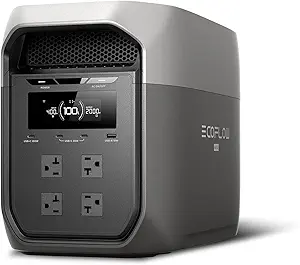
EF ECOFLOW DELTA 3 Max
- 2048Wh LiFePO4
- 3400W with X-Boost
- 0 to 80% in ~1.13h
The most capable unit on this list, by a wide margin. Enough stored energy to keep a fridge, router, lights and phones alive through a long outage, and an inverter that handles space heaters and power tools that stop smaller stations cold.
- Capacity
- 2048Wh
- AC output
- 3400W
- Chemistry
- LiFePO4

Availability changes through the day. Check the listing.
Learn more
The DELTA 3 Max is built around a large LiFePO4 pack, the chemistry rated for thousands of charge cycles rather than hundreds. Its inverter, helped by EcoFlow's X-Boost feature, drives heavy loads that most smaller stations refuse outright, including space heaters and power tools. Ultra-fast wall charging refills the bulk of its capacity in a little over an hour, so it is ready again quickly between uses, and optional solar panels turn it into a true off-grid generator. It is the heaviest pick here, so treat it as home backup first and a camping companion second.
Pros
- Largest capacity and strongest output on this list
- Refills most of its battery in roughly an hour
- LiFePO4 chemistry built for years of charge cycles
Cons
- Heaviest unit here, a two-person carry in practice
- Overkill, and overpriced, for light camping use
- Solar panels are sold separately
Best for: households that want serious backup power for outages, not just gadget charging.
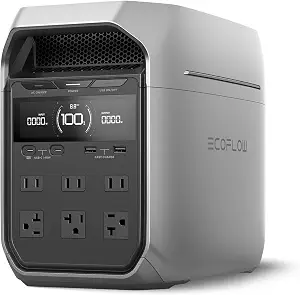
EF ECOFLOW DELTA 3 Plus
- 1024Wh
- 1800W AC
- 140W USB-C
The same DNA as the winner at half the stored energy, and for most households the smarter buy. The inverter still runs a fridge, microwave or coffee maker, and the high-wattage USB-C port fast-charges a modern laptop with no adapter brick.
- Capacity
- 1024Wh
- AC output
- 1800W
- USB-C
- 140W
Learn more
Half the capacity of the Max, a much friendlier price, and the same appliance-grade inverter behaviour where it counts. Like its bigger sibling it accepts optional solar panels and recharges from the wall remarkably fast, and it is an Amazon's Choice pick in its category with a slightly higher average buyer rating than the Max. If your outages are measured in hours rather than days, this is the sweet spot in EcoFlow's current lineup.
Pros
- Strong appliance-grade output at a mid-range price
- Fast-charges laptops directly over USB-C
- Slightly higher buyer rating than the larger Max
Cons
- Half the stored energy of the top pick, so long outages drain it sooner
- Still too heavy to call a camping unit
Best for: buyers who want real backup capability without paying for the flagship.
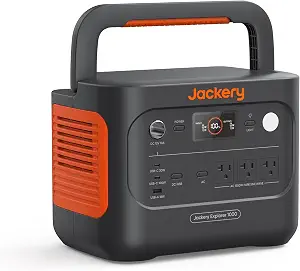
Jackery Explorer 1000 v2
- 1070Wh
- 1500W AC
- ~1h wall recharge
Nearly the same stored energy as the EcoFlow above, in a lighter body and at a lower price. The fold-flat handle makes it the one mid-size unit here that genuinely travels, and it carries one of the largest review counts on this list.
- Capacity
- 1070Wh
- AC output
- 1500W
- Recharge
- ~1 hour
Learn more
Jackery is the most recognised name in this category and the Explorer 1000 v2 shows why. The inverter covers most camping and emergency needs, from electric coolers to CPAP machines, and the battery is rated for a decade of regular cycling before meaningful degradation. It is the volume favourite here, with a steady stream of buyers reporting years of trouble-free use, and it recharges over solar with Jackery's optional panels.
Pros
- Excellent balance of capacity, weight and price
- Long-rated battery lifespan for regular use
- Huge, consistently positive review base
Cons
- Output ceiling is lower than the two EcoFlow picks above
- Solar panels sold separately
Best for: campers and RV owners who want the most proven mid-size station.
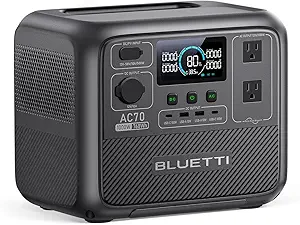
BLUETTI AC70
- 768Wh
- Power Lifting to 2000W
- 22.5 lbs
The one mid-size unit that punches above its class. Power Lifting mode lets a 1000W inverter drive kettles and hair dryers that would normally demand a far bigger station, and a single wall cable takes it to 80 percent in about 45 minutes.
- Capacity
- 768Wh
- AC output
- 1000W ×2
- Weight
- 22.5 lbs
Learn more
The AC70 sits in a smart middle ground: smaller and cheaper than the three picks above, but with a Power Lifting mode that stretches its inverter to handle simple resistive heating appliances. Charging is refreshingly simple, one cable to the wall with no bulky external adapter, and it tops up the bulk of its battery in well under an hour. At 22.5 pounds it is genuinely carryable for road trips, and it accepts solar, car and even lead-acid inputs for flexible off-grid recharging. Buyers rate it on par with the Jackery above, from a somewhat smaller review base.
Pros
- Punches above its size with resistive appliances
- Very fast, adapter-free wall charging
- Wide range of recharge input options
Cons
- Capacity covers a weekend trip better than a multi-day outage
- Power Lifting works on heating appliances, not motors
Best for: road trippers who occasionally need to run a heat-producing appliance.
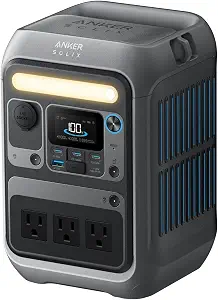
Anker SOLIX C300
- 288Wh
- 140W two-way USB-C
- Built-in light bar
- ~9 lbs
The grab-and-go pick for electronics. Bidirectional USB-C means it refills fast from a laptop charger and pushes power back out at the same high rate, and three full AC outlets are unusually generous for a unit this small.
- Capacity
- 288Wh
- AC output
- 300W
- Weight
- ~9 lbs
Learn more
Moving from the mid-size class into the compact class, the SOLIX C300 is Anker's take on a station you actually carry, and the build quality reflects the brand's charging pedigree. The standout is two-way USB-C fast charging, ideal for keeping notebooks and camera batteries topped off. A soft light bar across the front doubles as camp lighting. It cannot run large appliances, but for electronics-focused trips it covers everything most people actually bring along.
Pros
- Fast two-way USB-C charging in both directions
- Built-in light bar is genuinely useful at camp
- Light enough to carry with one hand
Cons
- Output suits electronics, not fridges or kettles
- 288Wh runs out fast if you power more than gadgets
Best for: weekend campers who mainly charge phones, laptops and camera gear.
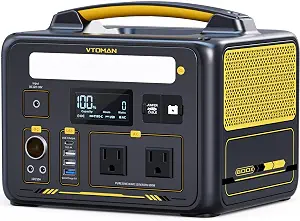
VTOMAN Jump 600X
- Built-in jump starter
- 600W / 1200W surge
- Pure sine wave
The only pick here that can crank a dead car battery. A dedicated jump-start port folds a roadside emergency tool into your camping power supply, and the inverter is stronger than the compact units around it.
- Capacity
- 299Wh
- AC output
- 600W
- Surge
- 1200W
Learn more
The Jump 600X brings one trick nothing else on this list offers. Beyond the jump starter, its 600W inverter is enough for small kitchen gadgets and power tools in short bursts, while pure sine wave output keeps sensitive electronics safe. Stored energy is similar to the compact picks around it, so think overnight trips rather than long outages, and the LiFePO4 pack should handle years of regular cycling. For anyone who spends real time on the road, the two-in-one design is a practical space saver.
Pros
- Only pick here that doubles as a car jump starter
- Stronger inverter than similarly sized rivals
- Pure sine wave output protects sensitive gear
Cons
- Slightly lower average rating than the picks above it
- 299Wh is an overnight capacity, not an outage capacity
Best for: drivers and RV travellers who want backup power and a jump starter in one.
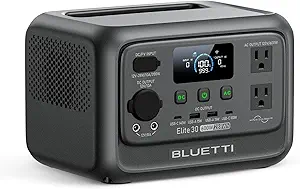
BLUETTI Elite 30 V2
- 10ms UPS switchover
- Power Lifting to 1500W
- 140W PD charging
The compact unit that behaves like a desktop UPS. It switches to battery fast enough that a computer or router never notices the grid dropped, which makes it as useful under a desk in storm season as it is in a tent.
- Capacity
- 288Wh
- AC output
- 600W
- UPS
- 10 ms
Learn more
Bluetti's compact entry borrows the power-stretching approach of its bigger AC70 sibling and adds the near-instant UPS mode that matters for home use. Eight charging modes and 140W PD fast charging cover most ways you would refill it. It shares the same capacity class as the Anker and VTOMAN around it, and buyer feedback consistently praises how quietly it runs compared to fan-heavy rivals. The rating trails the leaders slightly, mostly reflecting how new this model still is.
Pros
- UPS mode keeps computers alive through grid drops
- Handles heat-producing appliances beyond its size class
- Quiet operation noted consistently by buyers
Cons
- Newer model with a smaller review track record so far
- 288Wh only buys a desktop a short window, not a full workday
Best for: home offices that want seamless backup for a desktop or router.
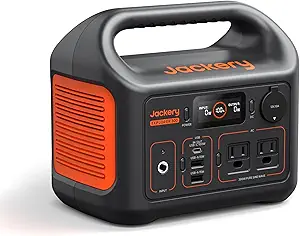
Jackery Explorer 300
- Most reviewed here
- 292Wh
- 7.1 lbs
The safest first power station on this list. A review count well into five figures dwarfs every other pick, and that longevity is the appeal: this design has been proven across years of campsites, tailgates and blackouts.
- Capacity
- 292Wh
- AC output
- 300W
- Weight
- 7.1 lbs
Learn more
The Explorer 300 is the elder statesman of this list. It is the lightest station here, easy to toss in a trunk or carry in one hand, and its port mix handles phones, tablets, CPAP machines and mini fridges on short trips. The inverter is modest, so it will not run kitchen appliances, and its interface feels simpler than the newer picks above. As a dependable first power station, it remains hard to argue against.
Pros
- Longest and largest review track record here by far
- Lightest unit on this list
- Reliable pick for CPAP users on short trips
Cons
- Modest inverter limits it to small electronics
- Older design, slower to recharge than newer models
Best for: first-time buyers who value a long, proven track record above all.
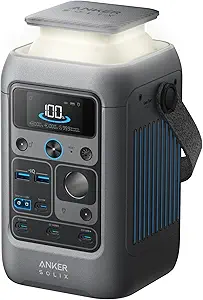
Anker SOLIX C300 DC
- DC only
- Built-in lantern
- Five USB ports
The same battery class as its AC sibling, minus the outlets, plus a lantern. A dense cluster of USB-C and USB-A ports and a car socket in a slimmer body with a shoulder strap, for kits where everything charges over USB anyway.
- Capacity
- 288Wh
- AC output
- None
- To 80%
- ~1.5 h
Learn more
This is the DC-focused sibling of the SOLIX C300 higher on this list: same battery class and the same trusted Anker build, but it drops the AC outlets entirely. In exchange you get a lighter, slimmer body with a diffused lantern built into the top and a shoulder strap for genuine portability. It is the right call if everything you own charges over USB, from phones and drones to laptops and camera rigs. One important caveat from the listing itself: no wall charger is included in the box, so you will need a higher-wattage USB-C charger you may already own.
Pros
- Dense USB port selection covers a full kit of devices
- Lantern top and strap make it a true camping lamp
- Slimmer and lighter than its AC sibling
Cons
- No AC outlets at all
- No wall charger included in the box
Best for: USB-only device owners who want maximum portability and camp lighting.
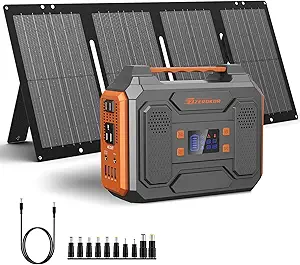
ZeroKor Portable Solar Generator
- Solar panel included
- 280Wh
- Pure sine wave
The only pick here with a panel in the box. Every other station sells its solar panel separately, which makes this the cheapest complete out-of-the-box solar setup on the list, ready for off-grid charging on day one.
- Capacity
- 280Wh
- AC output
- 300W
- Solar panel
- Included
Learn more
The ZeroKor bundles a foldable 60W panel and a full set of DC adapter tips at the lowest price here. Its capacity and output sit in the same small-electronics class as the compact picks above, suited to phones, laptops, fans and camp lights rather than appliances. The rating is the lowest on this list and the brand has a shorter track record than the established names, so set expectations at budget starter kit rather than long-haul workhorse.
Pros
- Solar panel included, no separate purchase needed
- Cheapest complete solar setup on this list
- Comes with a versatile set of DC adapter tips
Cons
- Lowest average rating here, from a newer brand
- A 60W panel takes most of a day to refill the battery
Best for: budget buyers who want a panel included from day one.
Side-by-side comparisonFilter by how you plan to use it and compare on one screen.
| Model | Capacity | AC output | Standout feature | Score | Review |
|---|---|---|---|---|---|
| 1. EF ECOFLOW DELTA 3 MaxBest overall | 2048Wh | 3400W | Runs space heaters and power tools | 9.8 | Open |
| 2. EF ECOFLOW DELTA 3 PlusBest value | 1024Wh | 1800W | 140W USB-C laptop fast charging | 9.6 | Open |
| 3. Jackery Explorer 1000 v2Best for camping | 1070Wh | 1500W | Full wall recharge in about an hour | 9.3 | Open |
| 4. BLUETTI AC70 | 768Wh | 1000W | Power Lifting up to 2000W | 9.0 | Open |
| 5. Anker SOLIX C300 | 288Wh | 300W | Two-way USB-C and light bar | 8.7 | Open |
| 6. VTOMAN Jump 600X | 299Wh | 600W | Built-in car jump starter | 8.4 | Open |
| 7. BLUETTI Elite 30 V2 | 288Wh | 600W | 10 ms UPS switchover | 8.1 | Open |
| 8. Jackery Explorer 300Most reviewed | 292Wh | 300W | Lightest here at 7.1 lbs | 7.8 | Open |
| 9. Anker SOLIX C300 DC | 288Wh | DC only | Lantern top, USB focused | 7.5 | Open |
| 10. ZeroKor Solar GeneratorLowest price | 280Wh | 300W | Solar panel included in the box | 7.2 | Open |
Swipe the table sideways →
What size do you actually needBuying too much capacity wastes money. Buying too little means the fridge goes warm anyway.
Find your power station
No sign-up. The recommendation updates instantly.
For gadgets on the tightest budget, this is the only pick that arrives with a solar panel already in the box.
Open the ZeroKor Portable Solar GeneratorGuidance based on the 10 models in this ranking. Always confirm wattage against the specific devices you plan to run.
How long will it actually last?Estimated runtime for a typical fridge, the single most common reason people buy one of these.
| Model | Capacity | Continuous AC | Portability | Typical fridge runtime |
|---|---|---|---|---|
| EF ECOFLOW DELTA 3 Max | 2048Wh | 3400W | Heaviest here | Roughly 10 to 20 hours |
| Jackery Explorer 1000 v2 | 1070Wh | 1500W | One-person carry | Roughly 5 to 10 hours |
| EF ECOFLOW DELTA 3 Plus | 1024Wh | 1800W | One-person carry | Roughly 5 to 10 hours |
| BLUETTI AC70 | 768Wh | 1000W | 22.5 lbs | Roughly 4 to 7 hours |
| VTOMAN Jump 600X | 299Wh | 600W | Compact | Roughly 1.5 to 3 hours |
| BLUETTI Elite 30 V2 | 288Wh | 600W | Compact | Roughly 1.5 to 3 hours |
| Anker SOLIX C300 | 288Wh | 300W | About 9 lbs | Not recommended |
| Jackery Explorer 300 | 292Wh | 300W | 7.1 lbs | Not recommended |
| ZeroKor Solar Generator | 280Wh | 300W | Compact | Not recommended |
| Anker SOLIX C300 DC | 288Wh | DC only | Slimmest here | No AC outlets |
Swipe the table sideways →
Before you check out
A fridge draws 100 to 200 watts while running, but its compressor spikes several times higher for a second or two at startup. That surge, not the average, is what a 300W inverter fails to handle. Estimates above assume compressor cycling and normal door use; opening the door less and setting the fridge slightly warmer stretches every number on this table considerably.
Set it up before the next outageThe worst time to learn how your power station behaves is in the dark.
- Charge it to full the day it arrivesDo not leave a new unit in the box at whatever charge it shipped with. Run it to 100 percent once, so you know how long a full wall recharge really takes in your home.
- Test your must-run devices nowPlug in the fridge, the CPAP, the router, whatever you actually bought it for, and watch the wattage readout. If the display shows the load sitting near the inverter's ceiling, you need a bigger unit, and you want to find that out today.
- Decide your recharge path in advanceWall outlet is fastest, a car socket works while driving, and solar needs a panel that most of these units do not include. Buy the cable or panel you will need before you need it.
- Store it at 30 to 80 percent, indoorsTop it up every three to six months. A battery left at zero for months, or parked in a hot car or a freezing garage, ages far faster than one that gets used.
Signs you sized it wrong
The unit shuts off the moment an appliance starts: the surge exceeded the inverter, so you need more watts, not more watt-hours. The battery drains in an hour with a light load: you need more watt-hours, not more watts. The fan runs loud and constant: you are running close to the continuous ceiling, which shortens the life of the unit.
Which one to choose for each situation
- Whole-home backup during outagesEF ECOFLOW DELTA 3 Max, the largest capacity and strongest output here. Open the review
- Serious backup without the flagship priceEF ECOFLOW DELTA 3 Plus, the same DNA at half the stored energy. Open the review
- Camping and RV trips with a proven brandJackery Explorer 1000 v2, the most trusted mid-size station here. Open the review
- Occasionally running a kettle or heaterBLUETTI AC70, whose Power Lifting mode handles resistive loads. Open the review
- Charging laptops and camera gear fastAnker SOLIX C300, with two-way USB-C fast charging. Open the review
- A jump starter built inVTOMAN Jump 600X, the only pick that can crank a dead car battery. Open the review
- Protecting a desktop or router from grid dropsBLUETTI Elite 30 V2, thanks to its near-instant UPS switchover. Open the review
- A first station with maximum peace of mindJackery Explorer 300, the most reviewed pick on this list. Open the review
- Powering a USB-only device kitAnker SOLIX C300 DC, a dense USB cluster with a lantern top. Open the review
- The tightest budget, solar includedZeroKor Portable Solar Generator, the only pick bundled with a panel. Open the review
Compact, mid-size or home backup: which class is yours
"Portable power station" covers three very different products, and picking the wrong class is the fastest way to end up with something that never leaves the closet.
- Compact, roughly 280 to 300Wh. Phones, laptops, cameras, fans, camp lights and a CPAP overnight. Light enough to carry in one hand, cheap enough to be a first purchase. It will not run a fridge, and no marketing claim changes that.
- Mid-size, roughly 700 to 1100Wh. The class that covers most real needs: a fridge for an evening, a microwave in bursts, a coffee maker, plus every gadget in the house. Still one-person portable, and the range where price and capability meet.
- Home backup, 2000Wh and up. A multi-appliance, multi-hour answer to a real outage, with an inverter strong enough for space heaters and power tools. Heavy, expensive, and worth it only if outages in your area last long enough to justify it.
Watt-hours and watts: the two numbers that decide everything
Every power station is defined by two figures that shoppers constantly mix up. Watt-hours (Wh) measure how much energy the battery stores, which becomes runtime: a 1000Wh unit runs a 50-watt device for roughly 20 hours, minus conversion losses. Watts (W) measure how much power the inverter can push out at any moment, which decides what you can plug in at all.
Match the wattage to the biggest single device you need to run, then match the watt-hours to how long you need to run everything combined. A big battery behind a weak inverter cannot start your microwave no matter how much energy it stores, and a strong inverter on a small battery runs that microwave for a couple of minutes. Features like EcoFlow's X-Boost and Bluetti's Power Lifting bend the rule slightly for simple heating appliances, but the two-number framework covers almost every decision in this category.
- Around 300W. Phones, laptops, lights, fans, CPAP machines. Nothing with a heating element or a compressor.
- 1000W to 1800W. Refrigerators, microwaves, coffee makers. The range most households actually need.
- 2000W and above. Space heaters, power tools and most household appliances, for a limited time.
Frequently asked questions
What can a portable power station actually run?
It depends on the inverter's continuous wattage. Small units around 300W handle phones, laptops, lights, fans and CPAP machines. Mid-size units around 1000W to 1800W add refrigerators, microwaves and coffee makers. The largest units can run space heaters, power tools and most household appliances for a limited time.
How long will one run my refrigerator during an outage?
A typical full-size fridge averages 100 to 200 watts once you account for compressor cycling, so a unit storing around 1000Wh generally keeps it cold for somewhere between 5 and 10 hours, and a 2000Wh-class unit roughly twice that. Opening the door less and setting the fridge slightly warmer extends that window considerably.
Is LiFePO4 really better than regular lithium-ion?
For this product category, yes. LiFePO4 cells typically survive 3000 or more charge cycles before dropping to 80 percent capacity, versus roughly 500 to 800 for older lithium-ion chemistry, and they are more stable at high temperatures. Nearly every current-generation station, including all ten on this list, has moved to LiFePO4 for that reason.
Do I need to buy a solar panel to use these?
No. Every station here charges from a regular wall outlet, and most also charge from a car socket while driving. Solar panels are an optional add-on for off-grid or extended-outage scenarios, and only one pick on this list includes a panel in the box.
Can a power station run a CPAP machine overnight?
Yes, and it is one of the most common uses. A typical CPAP draws 30 to 60 watts without a heated humidifier, so even the compact stations here can cover a full night of sleep. Turning off the heated humidifier and heated tubing significantly extends runtime on smaller units.
Are portable power stations safe to use indoors?
Yes, and this is their biggest advantage over gas generators. They produce no exhaust, no carbon monoxide and very little noise, so they can run safely inside a bedroom, apartment or tent. Gas generators must always stay outdoors, well away from windows and doors.
How should I store one when I am not using it?
Store it indoors at room temperature with the battery between 30 and 80 percent charged, and top it up every three to six months. Avoid leaving it at zero charge for long periods or storing it in a hot car or a freezing garage, since temperature extremes age the cells faster than regular use does.
How we evaluated these power stations
Our evaluation is editorial. We compare the most searched models on Amazon by cross-referencing manufacturer specifications with the reviews of people who already bought them.
- Battery capacity, how many watt-hours the unit actually stores, which determines runtime before a recharge.
- Continuous output power, the sustained wattage the inverter delivers, and whether it covers demanding appliances or only small electronics.
- Battery chemistry and lifespan, whether it uses long-lasting LiFePO4 cells and how many charge cycles it is rated to survive.
- Recharge speed, how quickly it refills from a wall outlet, and whether solar input is supported.
- Port selection, the mix of AC outlets, USB-C, USB-A and car ports, and whether it covers a household's devices at once.
- Weight and portability, whether one person can realistically carry it to a campsite or move it around the house.
- Cost-to-value ratio, whether the asking price lines up with the capacity, output and build quality delivered.
No brand pays for placement. Our links are affiliate links: if you buy through them we earn a small commission at no extra cost to you. Learn how we select products.
Conclusion
The right portable power station in 2026 comes down to two questions: what is the biggest thing you need to power, and for how long. For genuine home backup, the EF ECOFLOW DELTA 3 Max and DELTA 3 Plus lead with appliance-grade output and rapid recharging, while the Jackery Explorer 1000 v2 remains the most trusted mid-size choice for campers and RV owners.
In the middle of the range, the BLUETTI AC70 stretches beyond its size for heating appliances, the Anker SOLIX C300 excels at fast-charging electronics, and the VTOMAN Jump 600X adds a genuinely useful jump starter. The BLUETTI Elite 30 V2 brings desktop-grade UPS protection to storm-prone home offices, and the Jackery Explorer 300 is still the safest first purchase in the category.
For lighter needs and lighter budgets, the Anker SOLIX C300 DC covers USB-only kits with a clever lantern design, and the ZeroKor Portable Solar Generator proves you can get a complete solar setup without spending much at all. Decide on your must-run devices, size the capacity to your longest realistic outage or trip, and pick the model on this list that matches.